
- Director: Lorcan Finnegan
- Screenplay: Thomas Martin
- Cast: Nicolas Cage, Julian McMahon
- Cinematography: Radek Ładczuk
- Editing: Tony Cranstoun
- Score: François Tétaz
- Genre: Psychological thriller
- Runtime: 100 minutes
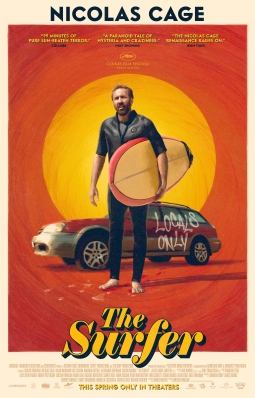
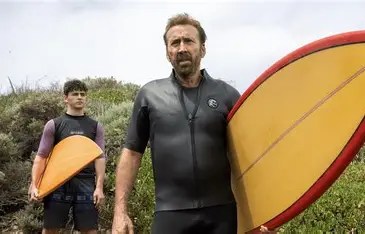
Nicolas Cage is ‘The Surfer’; from Australia, raised in the States but returned to the place of his upbringing so he can buy his childhood home. It’s on the side of a cliff, overlooking the beach he spent his youth catching waves. A house with that view doesn’t come cheap so the Surfer, intending to move his wife and son there, desperately tries to get in touch with his broker in order to procure enough funds to close the deal in time for Christmas.
He runs afoul of a hostile gang of surf-loving thugs who proclaim: ‘don’t live here, don’t surf here’ to non-locals. Not the most welcoming blokes.
In the constant shadow of the bullies, the Surfer spends the next few days practically living in the nearby car park, waiting in vain for the call from the broker. He gradually loses his personal possessions one by one; his shoes, watch, phone and his wedding ring are exchanged for various items. Material belongings are replaceable but with each item lost, a layer of his sanity is stripped away. He’s reduced to scrabbling in bins for a meal and there’s a moment where he bites a rat to sate his hunger. He is a broken man; desperation personified.
It’s the middle of an Australian summer, the sun beating down on beach-goers. The film is like a heat-induced dizzy spell; magnificently hallucinatory camerawork, zooming into the Surfer’s face, the clifftop house pictured in shimmering light as if it’s a mirage. The sublime cinematography really captures the sun-dappled locale, the sky an almost unworldly azure. Cage gives his usual over-the-top performance yet it actually works in his favour; it plays into the heightened sense of reality.
My rating: 9 / 10



 SilverScreen