
Apex (2026)

  • Director: Baltasar Kormákur
  • Screenplay: Jeremy Robbins
  • Producer: Ian Bryce, Peter Chernin, Jenno Topping, David Ready, Charlize Theron, Beth Kono, AJ Dix, Baltasar Kormákur, Will McCance
  • Cast: Charlize Theron, Taron Egerton
  • Cinematography: Lawrence Sher
  • Editing: Sigurdur Eythorsson
  • Score: Högni Egilsson
  • Genre: Survival
  • Runtime: 95 minutes

Frankly, you’d be a fool to indulge in rock climbing as a hobby. That’s what couple Sasha (Charlize Theron) and Tommy (Eric Bana) do. Have they got a death wish? Well, even for experienced climbers, there’s always the slightest chance things could go wrong and unfortunately, within the first 10 minutes, an unlucky fate befalls Tommy.

River deep, mountain high.

Five months later, Sasha swaps one biome for another. She’s done with icy peaks. She journeys to Australia, finding solace in water, with diving and kayaking becoming her latest leisure pursuits. The forests are so dense out there, the local bulletin board is covered in missing persons flyers. People aren’t advised to hike alone. Should Sasha take aid when it’s offered?

Not when it’s coming from lascivious blokes, nefarious intent telegraphed on their faces. A snake in her tent is the least of her worries. There’s something far more unpleasant; unwanted male company. Ben (Taron Egerton) steps in to break the tension. He’s a decent guy, right? Not quite. He’s worse than his compatriots. He takes pleasure in hunting Sasha through the trees, giving her a head start which helps her very little.

The film highlights the reality of being a solo female traveller. That’s where any authenticity ends. Baltasar Kormákur is on terra firma with this tale of survival; he also directed ‘Everest‘ and ‘Adrift‘. He knows what’s he’s doing. Yet the saturated lighting coats the drama with a sheen of artificiality. This is all the fault of Netflix, who only let their directors use approved cameras and prescribed technical specifications, thus limiting their creative freedom in favour of corporate uniformity. I think it’s a shame; you can tell Kormákur is putting a great deal of effort in.

It scrapes a pass. Egerton makes a credible psycho and there’s a dash of threat. Not at the apex of movies I’ve reviewed this year.

My rating: 6 / 10

Ladies First (2026)

  • Director: Thea Sharrock
  • Screenplay: Natalie Krinsky, Cinco Paul, Katie Silberman
  • Cast: Sacha Baron Cohen, Rosamund Pike, Charles Dance, Emily Mortimer, Tom Davis, Richard E. Grant, Fiona Shaw
  • Cinematography: Haris Zambarloukos
  • Editing: Mark Everson
  • Score: Atli Örvarsson
  • Genre: Comedy
  • Runtime: 93 minutes

The FTSE Women Leaders Review published last year reports that 43% of roles on company boards are female occupied. Okay, so not necessarily the head honcho at the end of the table but certainly having a seat in the room is a start. That’s not to say they’re treated any better socially or even listened to as ‘Ladies First‘ suggests.

Damien Sachs (Sacha Baron Cohen) has everything he could wish for: wealth, power and the ability to charm under-30-year-old women into bed (though I highly doubt they’d sleep with him if he wasn’t so financially secure). He also has something that automatically comes with having a dong: male privilege. A package deal.

In order to save his company’s neck, he promotes the underappreciated Alex Fox (Rosamund Pike), a lady chosen because she’s alphabetically first on the list of female candidates. She’s the token woman in the boardroom, there simply to fill a space and not expected to make a peep. Damien thwacks his noggin on a pole, his attention naturally on some fleeting blonde. He awakes in a gender-flipped society where women (such as Alex) wear the trousers and men are objectified in media. The boot of chauvinism now on the other foot.

By exclusively placing women in positions of authority, the writers fight fire with fire – a move that leaves everyone burnt. I felt it trivialised the all-too-real gender imbalance. The men have become campy and obsessed with personal appearance – if you dared to suggest the opposite, you’d be rightfully chastised. As for the alpha females, those ballbusting businesswomen, I just couldn’t take them seriously. Needless to say I think women belong in the boardroom, they absolutely do. But these caricatures of the respective genders are so exaggerated as to be unhelpful. With a British cast and director, and set in Britain, the concept isn’t required as much as it is in the United States (where the screenwriters hail from); a country in which the top job is yet to be assumed by a single woman.

My rating: 5 / 10

The Rip (2026)

  • Director: Joe Carnahan
  • Screenplay: Joe Carnahan
  • Cast: Matt Damon, Ben Affleck, Steven Yeun, Teyana Taylor, Sasha Calle, Catalina Sandino Moreno, Scott Adkins, Kyle Chandler
  • Cinematography: Juan Miguel Azpiroz
  • Editing: Kevin Hale
  • Score: Clinton Shorter
  • Genre: Action thriller
  • Runtime: 113 minutes

The Miami-Dade Police Department’s Tactical Narcotics Team receive a tip-off of a stash house: a property used for the storage of illegal goods – in this case, $20 million hidden behind a wall in the attic of a suburban home. The team; Lieutenant Dane Dumars (Matt Damon), Detective Sergeant JD Byrne (Ben Affleck) and three detectives (played by Steven Yeun, Teyana Taylor and Catalina Sandino Moreno) conduct a ‘rip’, a seizure of said assets.

Dumars (Matt Damon) starts acting erratic; confiscating everyone’s cellphones, not notifying his superiors. When he first got the tip, he gave his colleagues conflicting answers whenever they inquired as to the amount of money stashed. What’s he up to? Is he scheming to take a large chunk for himself?

The head honchos at Netflix would abscond with the cash, undoubtedly, so they can continue operating their conveyor belt of glossy yet hollow projects. How much dosh did they need to sway stars (and producers) Damon and Affleck into their fold?

The cops are the good guys, right? Working in law enforcement is a thankless job; mistreated by members of the public, constantly in danger of death on the front line. Could you honestly blame them for ‘earning’ a little on the side?

Twisty and confusing (in parts), ‘The Rip’ is watchable if nothing special. The use of lighting is superb however. The abode the raid occurs in is in an eerily quiet cul-de-sac, and as the squad’s mission takes place after hours, streetlights provide the source of illumination. An atmosphere of unease is created – both on the street and inside the garage where the dollars are counted, green light seeping through the windows.

My rating: 5 / 10

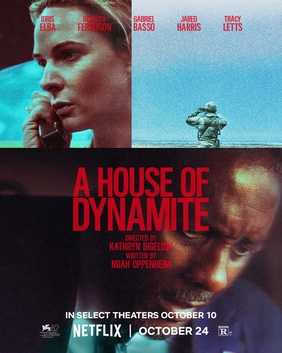
A House of Dynamite (2025)

  • Director: Kathryn Bigelow
  • Screenplay: Noah Oppenheim
  • Cast: Idris Elba, Rebecca Ferguson, Gabriel Basso, Jared Harris, Tracy Letts
  • Cinematography: Barry Ackroyd
  • Editing: Kirk Baxter
  • Score: Volker Bertelmann
  • Genre: Apocalyptic political thriller
  • Runtime: 112 minutes

We’re living in a world on a knife edge; nine countries possess nuclear weapons and have the capability to annihilate an opposing nation. From an American viewpoint, the most likely candidates for launching an attack against them are China, Russia or North Korea.

A chilling scenario plays out: at Fort Greely, Alaska, radars detect an intercontinental ballistic missile heading across the Pacific Ocean. We’re thrust into the frenzy of the White House Situation Room as the events unfold at an alarming speed. The missile is on course to hit Chicago, wiping out millions upon millions of civilians. The members of staff in the Situation Room have prepared for this eventuality a thousand times but when training becomes a reality, the panic sets in.

Less than 20 minutes till the Windy City is blown away, a conference call is arranged between the Situation Room, the Pentagon and commanders of the Armed Forces, joined by the Secretary of Defense and the President himself (Idris Elba). With the perpetrator unknown, the leader of the free world is put in an impossible position: does he launch a preemptive strike on enemy bases or risk more inbound missiles decimating cities?

None of the key players are one-dimensional characters. Everyone has a family of sorts, whether it be a pregnant partner, a young child or a detached relationship with a daughter. The story never deviates from the impending crisis yet these little glimpses into the interpersonal help to fully realise what could just be faceless identities rushing around.

Told in three chapters each from a different perspective, Kathryn Bigelow’s fictional portrayal of the United States government’s worst nightmare emanates tension right up until the last moment.

My rating: 7 / 10